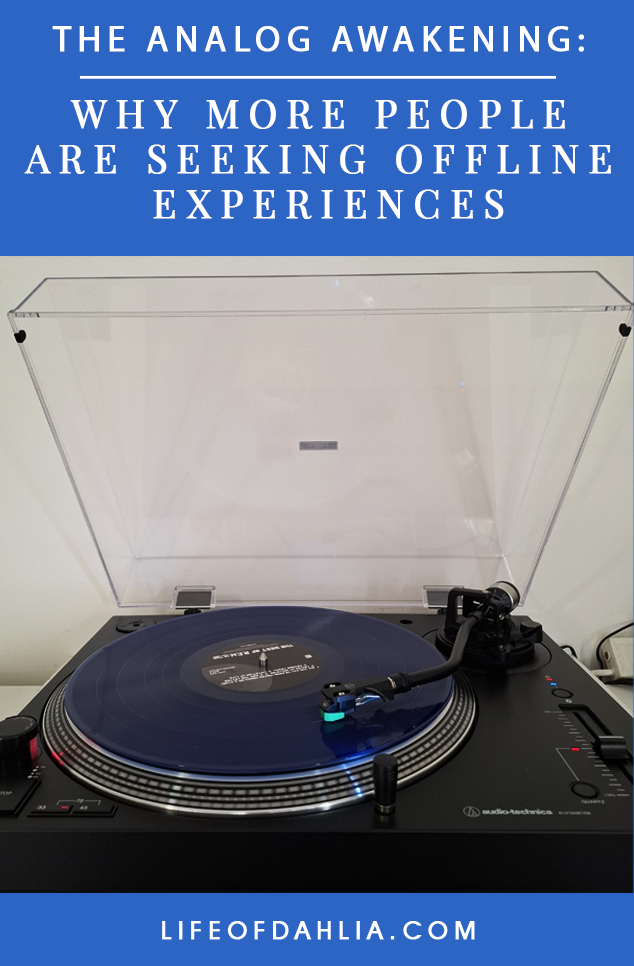
2026 has seen a notable rise in people seeking to spend more time offline and embracing a more analogue lifestyle. And if anything can inspire me to stay off my devices or at least try to find more balance with spending time on them, then I am here for it.
The irony of people posting online about spending more time offline and embracing a more analog lifestyle isn’t lost on me, but how else would we be inspired to do the same in the digital age, if not by seeing other people doing just that?
In the past few years, I have been trying to balance my time spent online and on devices with a more analogue approach, like going from a digital planning system back to an old-school paper one. Writing notes on paper instead of in the notes app on my phone (where they are often forgotten about because I can not see them) and limiting my use of devices by setting up systems to help prevent getting distracted, so that I can do other things and enjoy my offline hobbies without the need to be scrolling on Instagram.
In this post, I am going to be talking about ‘Why I think people are going more Analogue?’, ‘Why is it important to balance our use of technology?’ and ‘How you can also switch up some of your digital distractions with a more intentional analog approach?’ but also give you some insight into what I am doing in my life to prioritise this.
Let’s get straight into it, shall we…
📓 Why Are People Going Back To Analogue? 📓
I think there are a few key reasons why people want to go more analog. One example is ‘Internet Fatigue.’ We have spent so much time online, especially with the invention of the smartphone, that it has become a part of our daily lives, rather than a place we visit. And the recent COVID-19 pandemic just accentuated this as we were forced to work and communicate remotely.
I think that we spend so much of our time online and on devices that people want to get back to a more ‘Simpler’ time. A time when we used devices as a tool, and they didn’t demand our attention every 5 minutes. It’s really about regaining control over how we use them, but also about being conscious of what we consume, whether it’s constant news updates, scrolling on social media or binge-watching video media.
A couple of other key areas include a lack of ‘Tangibility’ and ‘Ownership’.
We consume so much digital content, and while you may have purchased a game, book or movie digitally, you don’t own it; you have just licensed it, and this is becoming an issue for some people.
We have gradually been moving towards a fully digital life, but the problem lies here: something fully digital lacks ‘Tangibility’ and true ‘Ownership’. You can not touch something digital; it exists in a non-physical space and could be lost at any time.
Files can be lost or erased (on purpose or by accident), accounts can be deleted (without your knowledge or control), your favourite music, TV shows and movies can be removed from streaming services at any time, and there is nothing you can do about it. Even a game or book you have purchased on a digital platform can be taken away from you or may become in accessible in the future.
There is, however, ‘Tangibility’ (and ‘Ownership’) in activities like writing your thoughts in a notebook instead of in the notes app on your phone, opening a CD and putting it in a stereo to listen to your favourite album, or taking out a DVD/VHS to watch a movie or TV show. These formats can’t be easily taken away from you because a streaming service removes them. They are also stuck in time, meaning they can’t be updated, changed or removed.
Because of how much our devices demand our attention, taking a step back and prioritising the need to ‘Slow down’ is something I think people really want and need. They are feeling burnt out and overstimulated, so instead, they want to prioritise a slower lifestyle. Opting instead for making purposeful moments of joy, capturing memories for themselves instead of needing to capture every moment to share online.
It’s about being more present, being in the moment and noticing what’s going on around them. And most definitely about getting their ‘Attention-spans’ back to a better level (thanks to social media and short-form media, they have decreased significantly overall.)
I think people also want to get back to proper forms of ‘Connection’ or ‘Communication’. Instead of clicking like or adding a brief comment on a friend’s post or group chats, they want to get back to long conversations on the phone with a friend or meeting with them in person for a coffee. They miss it. And especially after the Pandemic, where we were forced to take it online. Now that that has passed, we have this choice again.
📱 Why Balancing Our Technology Use is Important? 📱
Spending too much time online and on our devices can leave us feeling Stressed and Anxious. This is why we need to take breaks and set boundaries when it comes to using them. Reducing our screen time can improve our overall well-being, improve sleep, reduce eye strain from blue light, and help relieve stress and anxiety.
Our brains also need time to just be, so we can better process what is going on around us, and it also helps us to focus better for longer periods of time.
🤔 How Can We Start Transitioning To A More Analog Lifestyle? 🤔
Here are a few ideas on how you can change up your digital habits to a more analog alternative:
- 🗓️Change your digital planning system to a paper planner (even if you still use your calendar on your phone for appointment and event reminders. A paper planner can be a great way to brain dump everything first.)
- 📓Use a physical notebook or journal for your thoughts and ideas (again, this is great for brain dumping everything from your mind. You can sort through it later. Writing by hand on paper can be great for processing your thoughts.)
- 📞Call a Friend or Family member and arrange an in-person meet-up ☕. (Way better than a group chat. And you can chat about what you have been up to instead of just checking out their latest social media posts.)
- 🎨🖌️Try a physical hobby, something with no digital input. (Try something new or restart an old one. Try some cozy hobbies like colouring or reading a physical book instead of one on a device. Or try a group activity like doing a puzzle or playing a board game together.*)
- 📀Opt for watching a DVD over streaming* (It’s more intentional, and it has an end. Whether you watch a movie or a TV series, a DVD has an end, reducing your risk of binge-watching. But there can also be something magical about taking it out of the packaging and putting it in the player.)
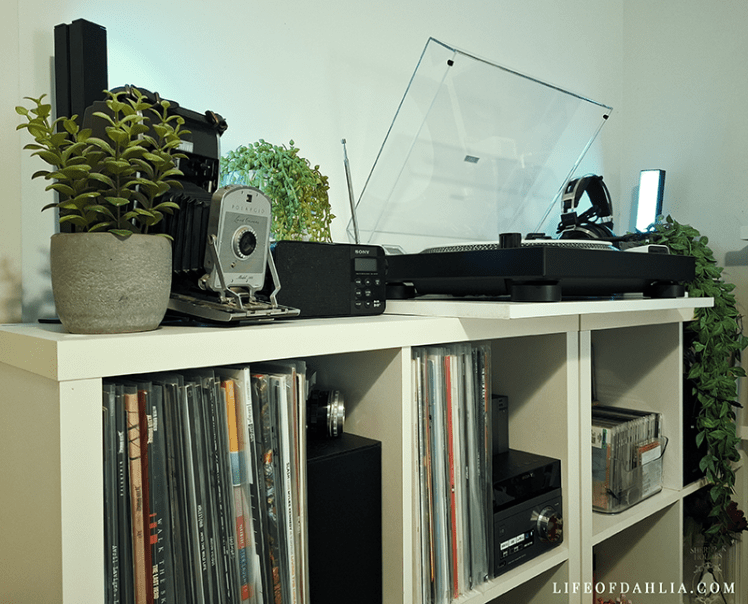
- 💿Start listening to music offline instead of using a streaming service. (This could be listening to old CDs, cassettes, vinyl records, or on a digital music player (MP3)**.)
*Check out your local library for CDs, DVDs, Books, and Board Games if you don’t already have some.
** You will need some music files for an offline digital music library. If you have any old CDs lying around, a CD drive for your computer and a Digital Music Player, then you have everything you need to start one. Alternatively, check out second-hand stores for CDs or purchase digital audio files through Apple Music/iTunes, Amazon Music or Bandcamp (for independent artists.)
I also recommend a music player that doesn’t require an internet or wifi connection. Bluetooth is fine as it’s usually used to connect to headphones or speakers. If you have one that does, turn on aeroplane mode or turn off the wifi.
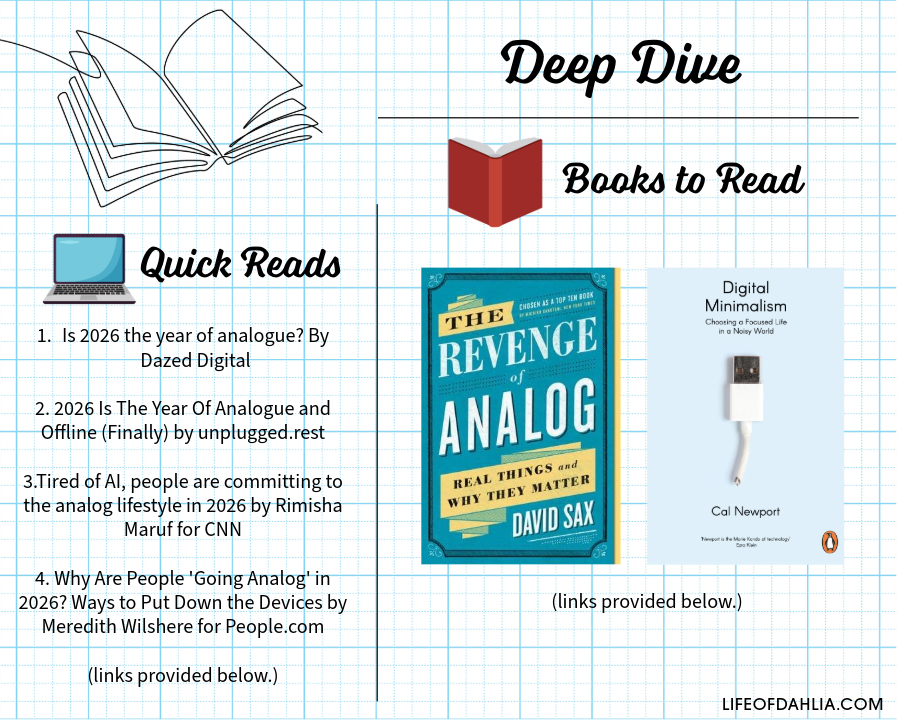
📚 Deep Dive – Reading and Content Recommendations 📺
Here are some reading and video recommendations if you would like to dive deeper into this topic.
📖 Books 📖
- Revenge of Analog by David Sax – This book talks about the Revenge of Analog in a digital age, from the resurgence of vinyl to notebooks, film photography, and so much more. (I recommend the audiobook version of this book as I found it better to digest than in written form. I recommend purchasing audiobooks through Libro.Fm as they allow you to download the files to your computer, which means you can listen to them offline on an internet-free device. You will also be supporting an independent book shop in the process.)
- Digital Minimalism by Cal Newport – This book outlines why we need to find balance with our technology use, how we can use technology more intentionally, and includes a 30-day digital detox plan if that interests you. (I did find this book a bit long-winded, but I liked the message, which is why I have included it here as a recommendation.)
📰 Articles 📰
Here are a few articles I came across while doing research for this post, and I wanted to recommend them:
- Is 2026 the year of analogue? By Dazed Digital
- 2026 Is The Year Of Analogue and Offline (Finally) by unplugged.rest
- Tired of AI, people are committing to the analog lifestyle in 2026 by Rimisha Maruf for CNN
- Why Are People ‘Going Analog’ in 2026? Ways to Put Down the Devices by Meredith Wilshere for People.com
📺 Videos 📺
Here are a couple of videos that I thought were worth watching:
- Why More People Are Choosing # Analog2026 — Burnout, Jobs & the Digital Exit (Chronically Offline) by Boss From Home on Youtube
- an analog life tips for living your best offline life & saving your creativity by becca is writing on Youtube
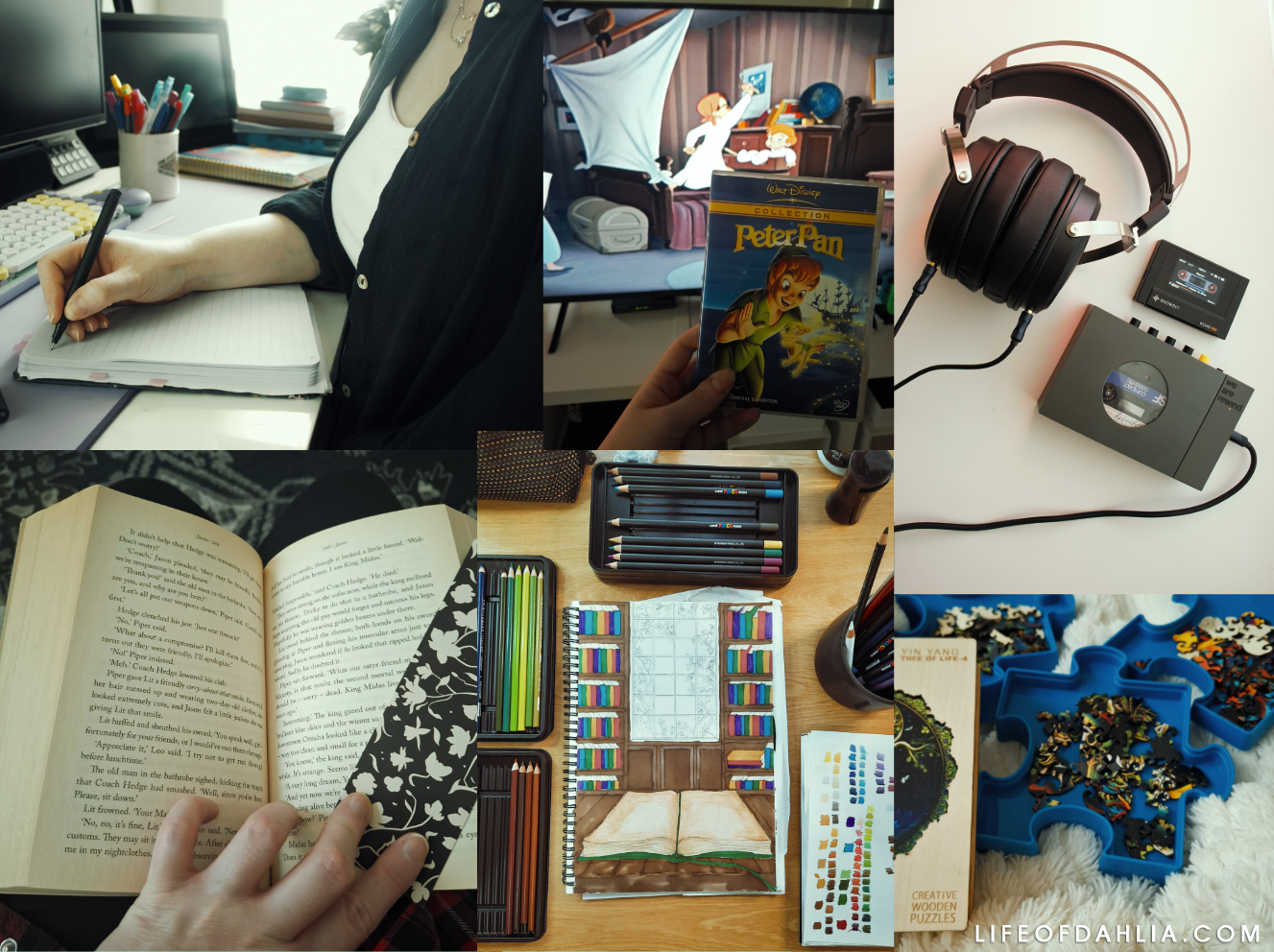
📓 📖 How do I Prioritise Analogue Activities? 📖 📓
I’ve gradually been changing the way I use technology to find more balance. I am prioritising offline alternatives where I can. Here are just a few ways I am changing things up:
- 📓📵Writing in Notebooks instead of note-taking apps – I use these for journaling, taking notes, even writing some of my blog posts in a handwritten form before transitioning to my computer. (This helps me to get my idea down in a rough form, which I can refine later on.)
- 📖Using a Paper Planner over a Digital one – I swapped over a year ago, and I’m not looking back. I do still use my Google Calendar for reminders, but I usually plan in my paper planner first.
- 🧩Embracing Offline Hobbies – like Reading, Journaling, playing board games, doing physical puzzles (not in an app), colouring, painting, etc.
- 📘Reading Offline – This can be reading physical paper books, E-readers that I disconnect from the internet, or listening to audiobooks on an MP3 player instead of on my phone.
- 📀🎧Consuming Media Offline – Watching DVDs over streaming from the internet when possible (I still have at least one or two streaming service and occasionally rent movies digitally, because I don’t need to own everything physically but I am prioritizing watching dvds as much as possible), Listening to music offline (like I used to), This looks like listening to an album on vinyl, CD, or cassette as well as digital music on an mp3 player. (I import and convert all my CDs to MP3-type files so that I can listen to them on the go.)
Seeing the change in the way people are trying to be more intentional in their lives and with the way they use their time online has been really inspirational, and while this has been something that I have been trying to do for a few years now, it makes me smile to see others do the same.
I also love seeing people going back to listening to old formats like vinyl or cassettes, but also watching old movies and TV shows on VHS and DVD. As someone who grew up in the time of Cassettes and VHS, this just makes me happy. No matter how or why people are choosing to go more analog, I think this is showing an important shift in people’s behaviour, and it shows our need for simplicity and finding joyful moments in a constantly changing world. One that is becoming a very stressful place to live.
This won’t be the last time I talk about this topic, as I plan to share more of this kind of thing in other posts, but it has certainly been an interesting one to dive into. I hope you will continue following along as we talk more about different ways to prioritize self-care.
Until next time, I hope you have an awesome day.
Erin
Disclaimer – This post is not sponsored and doesn’t contain any affiliate links; any links included are for reference only in case you are interested in checking out a mentioned link or purchasing a reviewed product. Check out my full Disclaimers here including Ai use on my blog.
AI was used to assist in creating the title for this blog post only; it was not used in the writing of the actual blog post itself.
Credits –
Research for this article –
- Is 2026 the year of analogue? By Dazed Digital
- 2026 Is The Year Of Analogue and Offline (Finally) by unplugged.rest
- Tired of AI, people are committing to the analog lifestyle in 2026 by Rimisha Maruf for CNN
- Why Are People ‘Going Analog’ in 2026? Ways to Put Down the Devices by Meredith Wilshere for People.com
- Why more Millennials are going ‘chronically offline’ and turning back to analog experiences by Jacalyn Wetzel for Upworthy.com
- The Power of Disconnect: Health Benefits of Reducing Screen Time and the Toxicity of Social Media by Chiropractic Health & Wellness
- The benefits of switching off: why digital breaks matter by NRMA
Images:
Images 1, 2, 3 & 5 are by Me (Erin Applebee)
Image 4 (deep dive) Created in Adobe Express, using Adobe Express Assets and book covers:
Revenge of Analog by David Sax cover image source (I don’t own the copyright to this cover; it is used for educational purposes only)
Digital Minimalism by Cal Newport cover image source (I don’t own the copyright to this cover; it is used for educational purposes only)
Image 5 – products featured (that I don’t own the copyright to): Peter Pan (is owned and copyrighted by The Walt Disney Company), Book featured is from the Heroes of Olympus series by Rick Riordan, puzzle by Jigfoxy, cassette player is by We Are Rewind, Headphones and MP3 player are by Filo and Snowsky.

Leave a Reply